Are PFAS Forever Chemicals In Your Tulsa Drinking Water?
PFAS “Forever Chemicals” are in Tulsa water. The question is, how much, and is it too much? The current results of the EPA study show results that border the current proposed maximum contaminant levels for regulatory standards.
How to Remove PFAS Forever Chemicals From Your Tulsa Water
There is no way for you to prevent PFAS Forever Chemicals contamination in the environment, but you can make sure the water you’re drinking is PFAS free. If there is good news regarding PFAS water contamination, it’s that they can be treated and removed from water with the right filtration. For example, several methods, like carbon filtration, ion exchange, and reverse osmosis water treatment effectively remove PFAS from water.
Removing PFAS Forever Chemicals from water is a complex process that requires advanced filtration techniques. Culligan offers several products that can help address PFAS contamination. Here are a few options:
Reverse Osmosis (RO) Systems: Culligan’s RO systems are highly effective in removing PFAS from water. These systems use a semipermeable membrane to filter out contaminants, including PFAS. The RO process can remove up to 99% of PFAS, providing you with clean and safe drinking water. Our Aquasential® Smart Reverse Osmosis Water Filter is the only product on the market certified by NSF to remove PFAS from your water.
Whole House Water Filtration Systems: Culligan’s whole house filtration systems can remove various contaminants, including PFAS, from all the water in your home. These systems provide comprehensive filtration, ensuring that every tap in your house delivers clean and safe water.
It’s important to note that the effectiveness of these filtration systems may vary depending on the specific type and concentration of PFAS in your water. To determine the best solution for your specific needs, I recommend reaching out to a Culligan Water Expert who can assess your situation and provide personalized recommendations. They will be able to guide you through the process and help you choose the most suitable product for your home.
Why Choose Culligan for PFAS Removal in Tulsa?
With PFAS contamination now recognized as a serious health risk—even at parts per trillion—Tulsa homeowners need advanced protection. Culligan offers industry-leading water filtration systems, including the Aquasential® Smart Reverse Osmosis System, the only NSF-certified product for PFAS removal. Whether you’re dealing with municipal water or a private well, Culligan provides free water testing, personalized recommendations, and proven filtration technology to help remove up to 99% of PFAS from your drinking water. Trust your local Culligan experts to deliver peace of mind—and cleaner, safer water for your family.
Solutions
Products to Remove PFAS
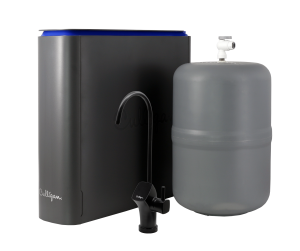
Aquasential® Smart Reverse Osmosis Drinking Water Filtration System
- 2-in-1 sediment and carbon filter screens out sediment and particles, reducing elements that cause water to taste and smell unpleasant, including the taste and odor of chlorine.
- Reduces dissolved substances such as radium, arsenic V, and many others. Various capacity membranes available.
- Optional specialty filters available providing a range of benefits including pH balance or the reduction of additional substances such as VOC, pharmaceuticals and mercury.
- A second carbon filter ensures your drinking water is cleaner and fresh.
- Manifold assembly molded using SteriTouch® resin, the patented single manifold ensures reliability and houses four separate filters.
- Premium metal construction faucet has water quality alerts and filter life indicators in an easy to read display.
- Durable, high-quality jacketed steel tank.
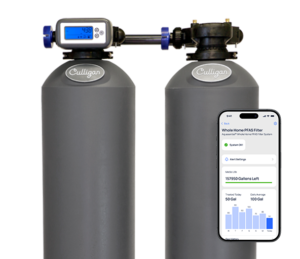
Aquasential® Whole House PFAS Water Filter
- Third-party certified to ANSI/NSF standards, the Aquasential® Whole Home PFAS Filter can reduce total PFAS by up to 99.9%.
- The PFAS filtration system operates effectively with minimal water pressure loss, even at higher flow rates.
- The built-in Smart Flow Monitor records the water treated by your system and calculates the remaining filter life, so you can always have the peace of mind that you’re getting optimal PFAS reduction.
- Easily check system performance, get alerts when filtration media needs to be changed, monitor water usage and set conservation goals using the Culligan Connect App right on your phone.
PFAS Forever Chemicals EPA Regulations
On April 10, 2024, the United States government introduced its first-ever national, legally enforceable drinking water standard to protect citizens from PFAS forever chemicals. The new rules to regulate six types of PFAS chemicals were developed based on feedback from the public and stakeholders, with over 120,000 comments considered. The EPA believes that these rules will protect about 100 million people from PFAS exposure over time, prevent thousands of deaths, and reduce tens of thousands of serious illnesses related to PFAS.
The EPA has also announced that it will be offering substantial funding, including $1 billion from the Bipartisan Infrastructure Law, to help test and treat PFAS in not only public water systems but address contamination in private wells as well.
The new regulations set limits known as ‘Maximum Contaminant Levels or MCLs’ for individual PFAS like PFOA, PFOS, PFHxS, PFNA, and HFPO-DA, as well as a combined limit for mixtures of PFHxS, PFNA, HFPO-DA, and PFBS. While these regulations will help to protect from 6 PFAS, there are over 15,000 PFAS chemicals.
The new regulations state areas exceeding the new standards of PFAS contamination must take action to reduce PFAS in their drinking water within 5 years.
The Environmental Protection Agency (EPA) has taken steps towards regulating PFAS in drinking water. In March 2023, the EPA proposed Maximum Contaminant Levels of 4 parts per trillion (ppt) for PFOA and PFOS. Finalized contaminant Levels are expected by the end of 2023. You can view the EPA’s proposed action for PFAS here.
EPA’s ongoing efforts under the Unregulated Contaminant Monitoring Rule (UCMR) involve collecting data for unregulated contaminants suspected in drinking water. This data aids in regulating such contaminants. The fifth UCMR phase (UCMR 5) requires sampling for 30 chemical contaminants, including PFAS, between 2023 and 2025.
Tulsa Water and its member utilities are actively participating in EPA’s UCMR 5 study, focusing on PFAS concentrations in treated drinking water. This collaboration aids EPA in setting PFAS regulations, with testing commencing in July 2023 for Tulsa Water and its members, and January 2023 for the City of Tulsa.
The results of the testing are presented by the delivery point sampled, its member utility served and the six PFAS which the EPA has set a proposed Maximum Contaminant Level of 4 ppt. The quarters of the results, July 2023, October 2023, and January 2024 can be found here. You can use tools such as XConvert to take the number and see it as ppb. Notice that not all chemical types are listed here or in the study.
For reference, a part per trillion (ppt) is roughly equivalent to a single drop of water in 20 Olympic-sized swimming pools or one second in 32,000 years. These updated interim Health Advisory Levels are below the detection capabilities of current laboratory testing technology. They serve as interim guidance until formal regulations or Maximum Contaminant Levels are established.
Why Is My Tulsa Water Contaminated With PFAS Forever Chemicals?
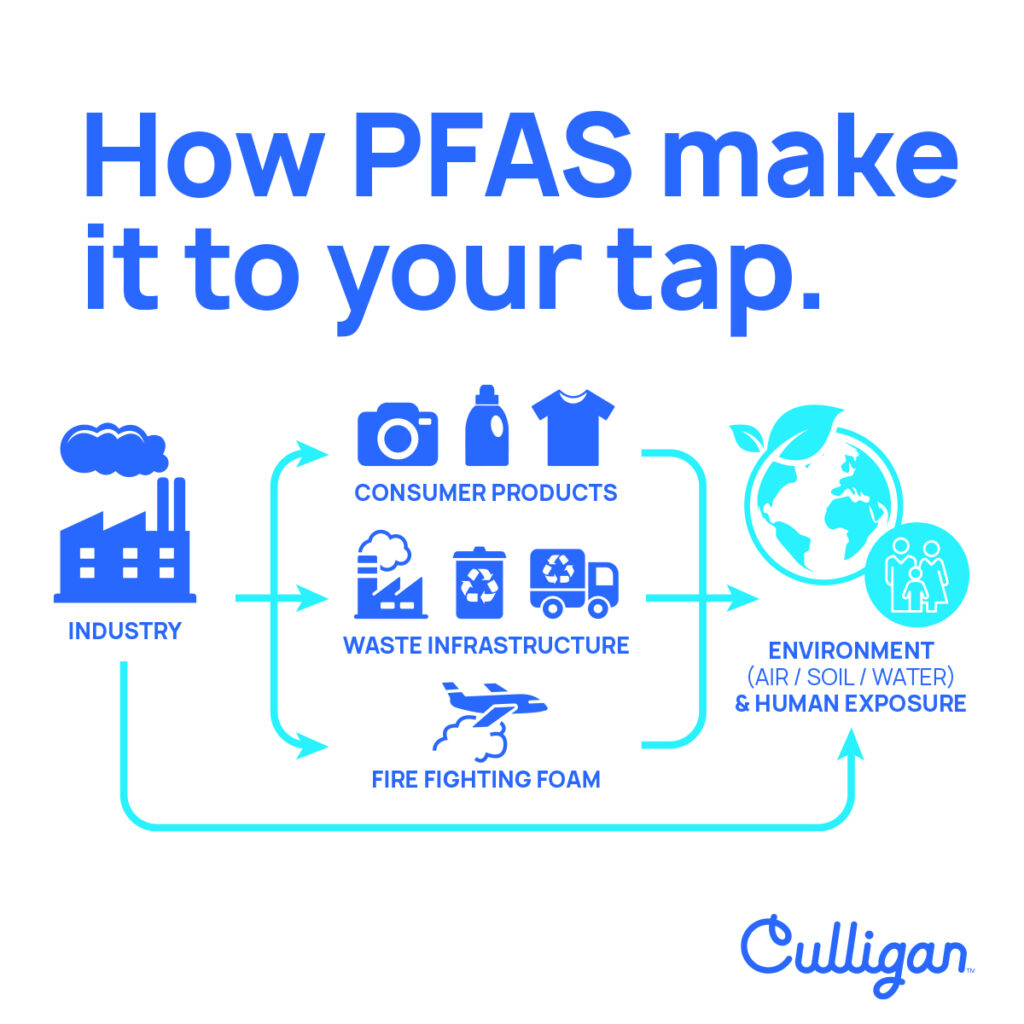
When it comes to PFAS-contaminated water, the situation can be particularly relevant to residents of Tulsa, OK, especially those serviced by Culligan. Certain areas are more susceptible to elevated levels of PFAS due to historical usage of these chemicals in various industrial and commercial activities. Tulsa, being a vibrant city with diverse zones of activity, might experience varying degrees of PFAS contamination in its water sources.
Living near specific sites, such as airports or firefighter training facilities, could put residents at a higher risk of encountering water with elevated PFAS concentrations. These sites historically utilized PFAS-containing foams for firefighting exercises and emergency response drills, which could have seeped into the ground and eventually reached the water supply. As such, individuals residing near these locations might be concerned about the levels of PFAS in their tap water.
Manufacturing centers in Tulsa are another area of focus when it comes to PFAS contamination. With its economic diversity, the city may have a history of manufacturing activities related to carpet production, food packaging, and various consumer goods. PFAS were commonly used in these processes due to their unique chemical properties. Over time, these chemicals might have entered the local water sources, potentially leading to higher concentrations in certain areas. This situation is particularly important to Culligan of Tulsa, as a water treatment and purification company, to address potential PFAS-related concerns in their service areas.
For residents of Tulsa, understanding the actual levels of PFAS in their water is crucial. Culligan, with its expertise in water treatment and purification, is well-positioned to provide essential information and potential solutions.
Further Explanation On What “Forever Chemicals” Are
PFAS, commonly known as ‘Forever Chemicals,’ water contamination impacts residents in many places across the United States, including the Tulsa area. The problem with PFAS and similar contaminants is that, until recently, few people knew or understood them. Compounding this issue, PFAS have become nearly ubiquitous in our environment.
It started in the early 1940s, when water and heat-resistant chemicals containing per- and polyfluoroalkyl substances were engineered to help create non-stick products (Teflon), fire retardants, and other common consumer goods. What wasn’t understood at the time, however, was that Teflon and other products using PFAS wouldn’t naturally decay in nature–or the human body.
Known as bioaccumulation, this chemical characteristic means any amount absorbed in our bodies – through eating or drinking – stays in our bodies. Since we have no way of removing or disposing of these chemicals, they’ve earned the ominous nickname, ‘forever chemicals.’ As a result, most PFAS have been phased out of use in this country. But they remain prevalent in the environment, and this includes our water supply.
Recommendations by the EPA For PFAS Forever Chemicals
The EPA holds the responsibility of overseeing the regulation of drinking water standards. While PFAS regulation in drinking water has not yet been established by the EPA, they have outlined suggested Maximum Contaminant Levels of 4 parts per trillion (ppt) for PFOA and PFOS. The EPA is anticipated to unveil the final regulations for PFOA and PFOS by the conclusion of 2023.

Facebook